Part Four—Touching the Divine: Chapters 13-19 and the Epilogue
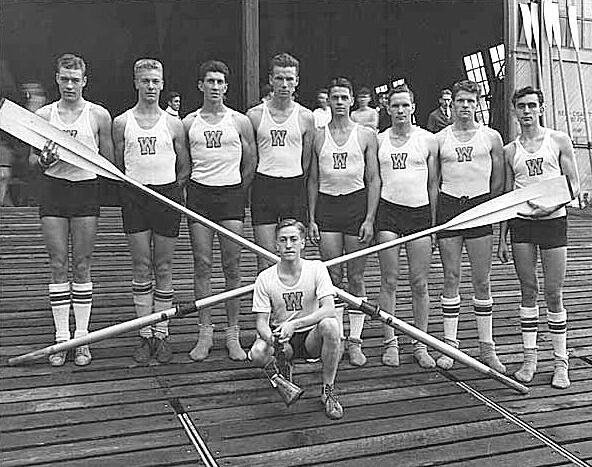
Photo from Washington Rowing
Finally, we reach Part Four. It’s all been building towards this: the 1936 Olympic Games.
There are a lot of tough decisions to make for Coach Al Ulbrickson in assembling the varsity team. He even drops Joe from boat one, though a month later he is moved back to the first boat, making the Olympics-hopeful boat. The final lineup is: Herbert Morris, Charles Day, Gordon Adam, John White, James McMillin, George Hunt, Donald Hume, Robert Moch, and Joe Rantz. But their work is far from over. They’ve got to make it to Berlin, and to do that, they must succeed at the Olympic Time Trials in New Jersey.
The men packed up as though they were headed to Germany and took a train to the east coast. With a now-signature come from behind victory, the Washington team was Olympics-bound! However, they needed to fund their own way, and fast. I thought it was admirable that Coach Ulbrickson kept the money issue a secret from the team, to keep them focused on their goal. Fortunately, the whole of Washington is supporting them, and they manage to raise $5,000 and set off for Europe, to put their skills to the most challenging test of all.
The voyage over was difficult: Hume became ill, people got seasick, some gained weight from lack of exercise, an Olympian even got expelled from the Games due to excessive drinking. Meanwhile, Germany, of course, was ramping up their wide-scale oppression but their propaganda team did their best to present a welcoming, peaceful facade. When the Americans arrived, they were impressed with the warm energy and had no idea of what was looming in the shadows.
Practice began and the Americans had the opportunity to view the other countries’ rowing teams: disciplined Germany, similar Britain, calm Netherlands. The Americans were still struggling to work together but slowly, they began to open up to each other and grow stronger. At the preliminary race, the Americans won and set a new world record, even with an ill Hume. The next day was the final and the Americans were at a disadvantage with the worst lane position. The weather was raging and when the race began, the American and British teams didn’t even notice! Even knowing the outcome, I was glued to the page, unsure of how a team so behind could make up the difference and emerge victorious.
The second to last chapter was told masterfully, every detail of the race on the page. But nothing beats archival footage to see pieces of the race. The video below in particular shows just how close the race was, with the American boat just barely winning gold. It was an extraordinary moment and after reading about the trials those men went through, what a glorious, well-deserved end!
Discussion questions for Part Four:
- Of course, we know the results of the 1936 Olympic Games. However, while reading about the race, what emotions did you experience? Were you so immersed in the story that you felt, for a moment, that the boys could lose?
- We were able to get a lot of Joe Rantz’s personal life told in this story. Throughout the book and in the epilogue, we learn more about the other members of the boat. Did you wish the author was able to provide a deeper dive on any other person in the book? Who would you want to know more about and why?
Thank you for joining our online discussion! Keep the conversation going with two All-Ages book discussions coming up:
Tuesday, July 23, 7:00-8:00pm in the Green Room at the Library OR Tuesday, July 30, 10:30-11:30am at the Rocky River Senior Center at 21014 Hilliard Blvd.
And join us on Friday, July 26 at 12pm: we will be showing The Boys in the Boat at our Movie Matinee!
 Read it or Weep