Boys in the Boat by Daniel James Brown: Part Four

Part Four—Touching the Divine: Chapters 13-19 and the Epilogue 
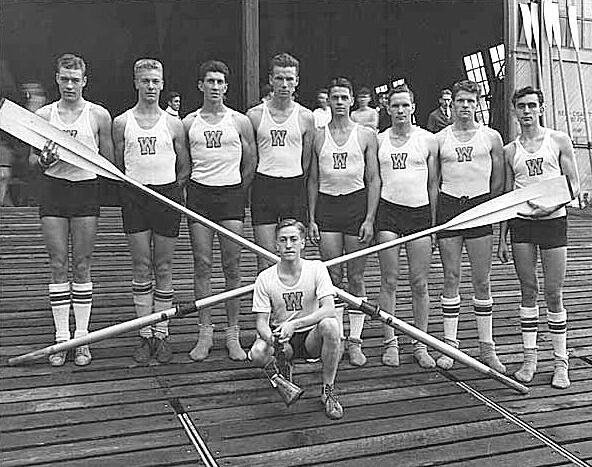
Photo from Washington Rowing 

Finally, we reach Part Four. It’s all been building towards this: the 1936 Olympic Games.  

There are a lot of tough decisions to make for Coach Al Ulbrickson in assembling the varsity team. He even drops Joe from boat one, though a month later he is moved back to the first boat, making the Olympics-hopeful boat. The final lineup is: Herbert Morris, Charles Day, Gordon Adam, John White, James McMillin, George Hunt, Donald Hume, Robert Moch, and Joe Rantz. But their work is far from over. They’ve got to make it to Berlin, and to do that, they must succeed at the Olympic Time Trials in New Jersey.  

The men packed up as though they were headed to Germany and took a train to the east coast. With a now-signature come from behind victory, the Washington team was Olympics-bound! However, they needed to fund their own way, and fast. I thought it was admirable that Coach Ulbrickson kept the money issue a secret from the team, to keep them focused on their goal. Fortunately, the whole of Washington is supporting them, and they manage to raise $5,000 and set off for Europe, to put their skills to the most challenging test of all.  

The voyage over was difficult: Hume became ill, people got seasick, some gained weight from lack of exercise, an Olympian even got expelled from the Games due to excessive drinking. Meanwhile, Germany, of course, was ramping up their wide-scale oppression but their propaganda team did their best to present a welcoming, peaceful facade. When the Americans arrived, they were impressed with the warm energy and had no idea of what was looming in the shadows. 

Practice began and the Americans had the opportunity to view the other countries’ rowing teams: disciplined Germany, similar Britain, calm Netherlands. The Americans were still struggling to work together but slowly, they began to open up to each other and grow stronger. At the preliminary race, the Americans won and set a new world record, even with an ill Hume. The next day was the final and the Americans were at a disadvantage with the worst lane position. The weather was raging and when the race began, the American and British teams didn’t even notice! Even knowing the outcome, I was glued to the page, unsure of how a team so behind could make up the difference and emerge victorious. 

The second to last chapter was told masterfully, every detail of the race on the page. But nothing beats archival footage to see pieces of the race. The video below in particular shows just how close the race was, with the American boat just barely winning gold. It was an extraordinary moment and after reading about the trials those men went through, what a glorious, well-deserved end! 

Discussion questions for Part Four:

  1. Of course, we know the results of the 1936 Olympic Games. However, while reading about the race, what emotions did you experience? Were you so immersed in the story that you felt, for a moment, that the boys could lose? 
  1. We were able to get a lot of Joe Rantz’s personal life told in this story. Throughout the book and in the epilogue, we learn more about the other members of the boat. Did you wish the author was able to provide a deeper dive on any other person in the book? Who would you want to know more about and why? 

Thank you for joining our online discussion! Keep the conversation going with two All-Ages book discussions coming up: 

Tuesday, July 23, 7:00-8:00pm in the Green Room at the Library OR Tuesday, July 30, 10:30-11:30am at the Rocky River Senior Center at 21014 Hilliard Blvd. 

And join us on Friday, July 26 at 12pm: we will be showing The Boys in the Boat at our Movie Matinee! 
Boys in the Boat by Daniel James Brown

Part Three- 1935 The Parts That Really Matter. Chapters Nine, Ten, Eleven, and Twelve.

In this part, we really start to see some storylines coming together. The goal stated on January 14th of 1935 declared they would forgo normal training with hopes to go to the Olympics the following year. This sets a different tone as these rowers have in the span of a year gone from fighting for a spot on the freshman team to working towards becoming Olympic champions. We really don’t hear much about what the boys and Joe were thinking about this other than their stress. We see their struggle from the perspective of Ulbrickson and his personal struggle. As much as he wanted to recapture the magic from the Poughkeepsie freshman race of the previous year, the sophomore team just wasn’t predictable. I’ve had problems, particularly with machines where sometimes they’ll work and other times they won’t. I understand to some extent the frustration of seeing the sophomores row well sometimes and other times struggle to keep up with the older students.

The buildup and the excitement for the races in this part are exhilarating. With the sophomores assigned to the varsity boat, they consistently win the races. They don’t consistently beat the older boys though. So when it comes to this year’s competition at Poughkeepsie, the older boys get to race as the varsity only to lose. The older boys lose the varsity race at Poughkeepsie and lose the 2000 meter exhibition run. With 2000 meters being the Olympic length, it must have really hurt their morale. The University of Washington seemed to have the raw talent, but they struggled to create a proper team to prove they deserved a shot at the Olympics.

Joe’s personal life is still very tumultuous at this point. Joe finds where his family has been living, is rejected by Thula again, secretly visits his siblings, Thula dies, and his father suggests they live together again. Joe’s personal life feels like a whirlwind. It’s hard to imagine being a young man with all this family drama, struggling to pay for your tuition, and still managing to find time to be on the crew team as well as date Joyce. We get a better understanding of the other boys on the crew team as Joe sees them in a more humanizing light outside of crew. Joe starts to develop a connection with George Pocock as the new year of training begins in the fall.

Both in the United States and in Germany, the Nazi problem is becoming more and more apparent. Jewish people are losing their rights as their society turns against them. Americans vote on whether to boycott the Olympics, but the vote fails. The people sent to Germany to see the Olympic facilities are fooled. Brundage manages to fool the public by saying he is an advocate for the Jewish people, yet using arguments to minimize their suffering and doubt themselves. This book paints a vivid picture of the manipulations that were happening at the time.

Discussion questions for Part Three:

What did you think of the excitement of the California races with the sophomores appointed as varsity as well as the upset JV team? Do you think the results would have been different if the older boys had raced the California varsity?

Have you ever had a moment like Joe had after the California race where you felt truly celebrated for your accomplishments?

Let us know how your thoughts! Come to one, or both, of our All Ages Book Discussion:

Tuesday, July 23, 7:00-8:00pm in the Green Room at the Library OR Tuesday, July 30, 10:30-11:30am at the Rocky River Senior Center at 21014 Hilliard Blvd.

Boys in the Boat by Daniel James Brown

Part Two – 1934 Resiliency Chapters Six, Seven, and Eight

And on we go to the next three chapters!!

The author’s ability to take small, seemingly unimportant moments and turn them into something that feels like a Dramatic Moment makes it hard to put this book down (imho). Take for example the unexpected race between the freshman and varsity boats coming in from practice (page 85), and readers can almost see the wheels start turning in Coach Ulbrickson’s mind. Figuring out how to get the same response on a regular basis, is it the day or is it the mix of rowers or is something intangible? And how can his team keep up with the other West Coast teams University of Washington needs to defeat before they can move onto the East Coast teams? All of this is giving us a better perspective on what challenges lay ahead for our Boys in the Boat, while also keeping us on the edge of our seats..

Possible questions for discussion from Part Two:

1. Do you think Ky Ebright was right to complain about George Pocock? If you were Mr. Pocock, how would you have responded?

2. Now that you’re more acquainted with how small differences in the shell, oars, and the positions people are assigned, what do you think made the University of Washington’s Freshman Team so successful? What position do you think you’d be assigned? 

3. Did you know how long the high temperatures and drought conditions were present in the 1930s? What kind of daily impact do you think that had on the people of the Midwest and Great Plains? How do you think it affected the people we’ve met in this book?

4. Were you surprised to find out where Harry and Thula wound up? What would you have done if you were Joe?

5. Part two is focused on the resiliency of people, and also a little bit on the Western red cedar too. Did you know how much the materials going into the equipment would matter? Are you feeling inspired to start building anything out of the native plants found in Ohio? 🙂 

6. Will you be watching the 2024 Paris Olympics Rowing Competition, starting on July 27th? You have time, so why not get to know US Rowing Eight+ boat class Teams before the games begin!

Let us know how your thoughts! Come to one, or both, of our All Ages Book Discussion:

Tuesday, July 23, 7:00-8:00pm in the Green Room at the Library OR Tuesday, July 30, 10:30-11:30am at the Rocky River Senior Center at 21014 Hilliard Blvd.

See you in just a few weeks! -Stacey